1930s
The Glass MenagerieThe 1930s are the historical setting through which the play connects the Wingfield family’s private troubles to economic collapse and social change. Tom presents the era as a time when the middle class confronted a dissolving economy, while Amanda’s memories of the Mississippi Delta preserve a vanished world of planters, callers, and servants. The contrast makes the decade both a material hardship and a contested object of memory.
Historical and Economic Setting
Tom introduces the period by saying that the play turns back time to the thirties. He describes the American middle class as effectively blind to the crisis confronting it, forced to encounter the failing economy as if learning a painful alphabet by touch. The image frames economic hardship not as distant background but as a pressure that shapes ordinary life and constrains what people can expect from the future.
The social setting also includes unrest beyond the family. Tom contrasts revolution in Spain and the destruction of Guernica with shouting, confusion, and labor disturbances in the United States, naming Chicago among the cities where those disturbances could become violent. He identifies this turmoil as the play’s social background, setting the Wingfields’ personal conflicts within a wider period of insecurity rather than presenting them as isolated misfortune.
Amanda’s Recalled South
Against that unsettled present, Amanda recalls her youth in the Mississippi Delta as a world of social standing and abundance. She tells Laura that one Sunday in Blue Mountain she received seventeen gentlemen callers, with so many visitors that the household needed additional chairs. She remembers prominent young planters and their sons among her suitors, measuring the past through their family connections, prospects, and attention to her.
Her stories make the old order vivid through individual names and fates. Champ Laughlin later became a bank vice-president; Hadley Stevenson drowned and left his widow government bonds; Bates Cutrere died after a quarrel at Moon Lake Casino, and his widow inherited thousands of acres. Amanda also recalls the celebrated Fitzhugh boy, then clarifies that he never married. The details preserve her world as a web of courtship, money, reputation, and remembered loss, even as Tom’s questions gently puncture the assumption that all her former admirers met the same end.
Memory and Present Hardship
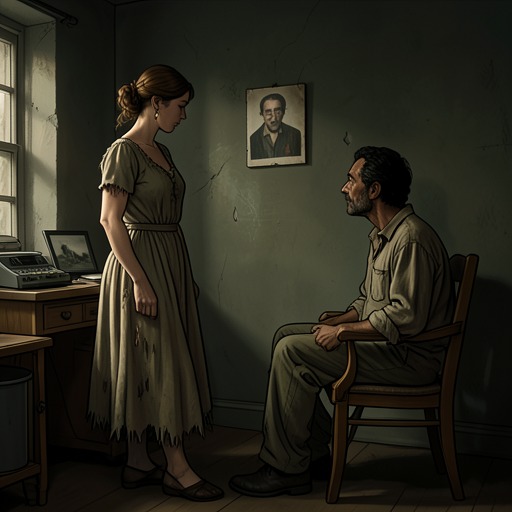
Amanda’s attachment to that past becomes clearest when she models her future with Laura against it. She fears that without a business career, they will depend on relatives and live in cramped, precarious circumstances; she describes this prospect through the image of unmarried women without a secure home. Her recollections of gracious Southern living therefore coexist with a present in which the family has neither the resources nor the social arrangements she once expected. She acknowledges that she did not marry a planter but a telephone-company employee, who later left to travel, and contrasts the imagined household of land and servants with the life she actually has.
The economic pressure is also concrete. Amanda recalls that fifty dollars in tuition and her hopes for Laura’s business education disappeared when Laura could not continue, while Tom says he earns sixty-five dollars a month at the warehouse and resents the life he believes that work requires of him. Amanda’s memory of a privileged past cannot resolve these immediate limits; instead, its contrast with their present dependence gives the family’s financial anxiety a historical and personal dimension.
The Decade as Dramatic Time
The play’s treatment of the 1930s is filtered through memory rather than offered as detached historical narration. Tom announces that the play is a memory, and that its dim lighting, sentiment, music, and departure from realism belong to that form. The decade’s history and Amanda’s recollections consequently arrive as selected images and stories, not as a comprehensive account: public economic crisis stands beside a family’s private memories of status and loss.
That structure also makes the past unstable. Amanda can revive the dress she wore at dances and the jonquils associated with her youth, but those recollections lead back to the moment she met the man who became her husband—and to the present household she did not expect. The 1930s thus hold together two pressures: the economic world that narrows the family’s choices and the remembered Southern world through which Amanda tries to imagine what has been lost.